








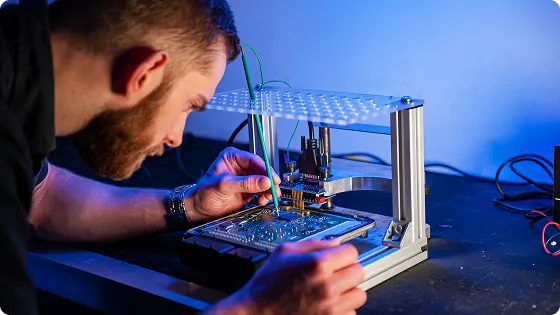
ECU REMAPPING
& PERFORMANCE
SOFTWARE
Celtic Tuning develops all performance software entirely in-house. Every ECU remap we produce is written, dyno-tested and datalogged by our own engineers — not purchased, not resold, not generic. What leaves our facility is calibration built around your engine, not adapted from someone else's work.

WHAT IS ECU REMAPPING?
Every modern engine is governed by an Engine Control Unit — a processor that manages fuelling, ignition timing, boost pressure, throttle response and a range of other parameters. Manufacturers program these systems to accommodate global emissions regulations, varying fuel quality, different market requirements and wide service intervals. The result is an engine that is, in most cases, deliberately operating below its mechanical capability.
ECU remapping is the process of modifying the software to recalibrate these parameters — recovering the performance the engine is capable of, and in many cases extending well beyond factory limits where hardware supports it. At Celtic Tuning, this process begins not with the tune itself but with a full understanding of the ECU's control strategy: how it reads sensors, how it makes decisions, and precisely where the factory has imposed its constraints.
Without understanding the ECU's strategy in full, true performance gains simply cannot be achieved.


STAGE 1 REMAP
A Stage 1 remap is a software-only modification — no hardware changes required. It is the most accessible and most popular form of ECU remapping, suited to vehicles in standard factory specification. The calibration is written to work safely and effectively within the limitations of the standard hardware: fuelling system, turbocharger, intercooler, exhaust and air intake.
The process at Celtic Tuning begins before a single parameter is changed. The vehicle's ECU software is read and fully decoded — using the vehicle's DAMOS data and Funktionrahmen architecture — to identify where the factory has imposed restrictions that are not related to mechanical limits. Free power is recovered first. Fuel and boost are then calibrated on the dyno with full data logging across all critical channels.
Select your vehicle

WHAT A STAGE 1 REMAP TYPICALLY IMPROVES.
Typical results vary by engine and vehicle but commonly include increased power and torque output, improved throttle response, smoother power delivery through the rev range and, in many applications, improved fuel efficiency on diesel applications under normal driving conditions.
The confidence behind our Stage 1 remap software is rooted in the thoroughness of its development. Engine management systems are engineered to deliver a consistent driving experience across every vehicle of the same make, model and variant — so that regardless of which example you get into, the power delivery and behaviour feel the same. ECU calibration works on precisely the same principle. Software developed and validated on the rolling road for a specific engine variant is designed to deliver consistently across other vehicles of that specification. Celtic Tuning software is available both directly through our facilities and via our dealer network and mobile service across England and Wales. Should any vehicle perform differently — whether due to wear, sensor variation or any other factor — our ability to custom-tune the software to that specific vehicle is always available.

Suitable for standard specification vehicles — no hardware modifications required

All software written in-house — not a generic off-the-shelf file

Dyno-tested and data-logged as standard

14-day satisfaction guarantee on all remaps

Available for petrol and diesel engines across cars, vans and light commercial vehicles

STAGE 2 REMAP
A Stage 2 remap is designed for vehicles that have undergone hardware modifications — typically an uprated intercooler, performance exhaust or induction kit. A Stage 1 calibration will continue to function with Stage 2 hardware fitted, but it will not be written to take advantage of the uprated components. To realise the full benefit of the hardware investment, the calibration must be written specifically around what has been fitted.
This is where the limitations of generic or purchased software become apparent. A Stage 2 calibration cannot be lifted from a library — it has to be developed around the specific combination of hardware on that vehicle. At Celtic Tuning, Stage 2 work is conducted with the vehicle on the rolling road throughout development, with live data across boost pressure request and actual, fuel rail pressure, exhaust gas temperatures, lambda, injector duty cycle and knock.
For vehicles where development work extends beyond our dyno facility, we conduct high-speed testing at circuits including Silverstone and the Nürburgring to validate long-term performance and rule out any limp-mode conditions under sustained load.
Select your vehicle


Requires hardware modifications to be fitted and verified before tuning begins

Calibration written entirely to your vehicle's specific hardware specification
Full dyno development and data logging as standard
Available for petrol and diesel — cars, vans and performance applications

STAGE 3 & BESPOKE PERFORMANCE TUNING
For vehicles running significant turbo upgrades, uprated fuelling systems, built engines or full engine conversions, calibration moves beyond stage definitions entirely. Turbo upgrades typically fall into this category, though the appropriate stage always depends on the specific restrictions of the engine in question — some applications may be addressed at the Stage 2 level where engine constraints allow. This is bespoke performance tuning — work that is developed from the ground up for that specific vehicle, combination of components and intended use.
Celtic Tuning regularly undertakes this level of work across a wide range of vehicles — including high-end performance cars such as Lamborghini, Ferrari and McLaren, as well as heavily modified road and track vehicles. The process is entirely bespoke: no two files are the same, and development time on the rolling road reflects the complexity of the application.
Select your vehicle

HOW WE READ YOUR ECU
Reading an ECU is not a single process — the method depends entirely on the age of the vehicle, the ECU type and the level of manufacturer protection in place. Celtic Tuning works across every generation of ECU technology, from vehicles built before electronic engine management was commonplace through to the latest protected units requiring specialist intervention.
Chipping — Pre-2001
On pre-2001 vehicles, there is no OBD port or electronic read/write capability. Modifying the software requires physically desoldering the EPROM chip directly from the ECU's PCB and either reprogramming or replacing it. This is the original form of chip tuning and remains the only viable method for vehicles of this generation.
OBD — 2001 onwards
From 2001 onwards, the OBD port became the standard interface for reading and writing ECU software. It is the most common method used in modern ECU remapping — non-invasive, with no requirement to remove or open the ECU. However, OBD access is increasingly restricted on newer vehicles due to many manufacturers developing anti-tuning protection.
Bench pin-out
Bench pin-out was introduced as part of the process of unlocking later TriCore-based ECUs and has since become a widely adopted reading method in its own right. It does not require the ECU case to be physically opened — instead, direct connections are made to the ECU's external pinout, allowing a full read of the software. It is a more thorough method than OBD alone and is used where OBD access is insufficient.
Boot mode
Boot mode has been in use across different ECU generations since the early days of engine management. It involves opening the ECU and connecting directly to the processor via pads on the PCB — bypassing the normal communication channels entirely. Where OBD and bench pin-out cannot achieve a full read, boot mode is often the solution. It requires physical access to the ECU internals and careful, experienced handling.
Unlocking MD1 / MG1 and current generation ECUs
Since June 2020, the introduction of Bosch MD1 and MG1 ECUs has brought with it a new level of tuning protection. For several years the only route to read and write access was a remote unlock: the ECU was sent to a specialist tool manufacturer and returned unlocked, adding a lead time of three to seven working days before calibration work could begin.
That has now moved on. Using EMP glitch unlocking, a growing number of these ECUs can be opened and unlocked in-house, with the read, calibration and write carried out in the same visit. Where a particular ECU is not yet supported by the glitch method, the remote unlock route still applies, and we confirm which applies to your vehicle at the point of booking.
ECONOMY REMAPPING
Not every ECU remap is about outright performance. For fleet operators, commercial diesel vehicle owners and high-mileage drivers, economy remapping offers a recalibration focused on fuel efficiency — adjusting throttle mapping, torque delivery curves and fuelling parameters to reduce consumption under typical driving conditions. Celtic Tuning offers economy remapping on diesel vehicles only. Whilst some customers on turbo petrol applications report fuel consumption improvements following a remap, this is something we will never claim or guarantee — where it occurs, it is a by-product of better calibration, not a defined outcome of the work.
Celtic Tuning has completed economy remap programmes for a range of commercial operators, including Cornwall Council and Kelly Services. The software is developed with the same in-house process as our performance work — dyno-logged and data-verified — with the calibration target shifted from peak output to efficiency across the operating range.
Suitable for diesel cars, vans, HGV and light commercial

Fleet programmes available — multiple vehicles, consistent calibration
Same in-house development process as performance remaps

Fuel saving results vary by vehicle, driver behaviour and use case
HOW OUR SOFTWARE IS DEVELOPED
All performance software developed by Celtic Tuning is written entirely in-house. We do not purchase calibrations, licence files from third parties or adapt generic maps. Every file begins with a full read of the vehicle's ECU software and a complete analysis of its control strategy using DAMOS data and Funktionrahmen architecture — the framework that defines how the engine management system communicates, reads its sensors and governs the engine.
The objective at this stage is not to add power — it is to understand the engine fully. Factory-imposed restrictions that are unrelated to mechanical limits are identified and addressed first. Only once that headroom is established does calibration for additional fuelling and boost begin.
Our team includes BMW-trained mechanical technicians alongside experienced ECU calibrators. Every file is developed and validated on the rolling road with live data logging across all critical parameters before any vehicle leaves our facility.
The development process:
Read - Full ECU software read and control strategy analysis.
Reverse engineer - DAMOS and Funktionrahmen decoded to identify factory restrictions.
Write - Calibration written entirely in-house from first principles.
Dyno & log - Rolling road development with full data logging: boost, fuel pressure, EGTs, lambda, N75 duty, ignition advance, knock.
Refine - Iterative development until data confirms a safe, optimal result. For in-house development vehicles, extended to high-speed circuit testing at Silverstone and the Nürburgring to validate performance under sustained load.
VEHICLES COVERED
Celtic Tuning develops ECU remapping software across an exceptionally wide range of vehicle types. Coverage includes passenger cars, light vans, HGV and commercial vehicles, agricultural and plant machinery, marine engines and motorsport applications — for both petrol and diesel engines across all major manufacturers.
Our approved dealer network spans over 200 partners across 35 countries, each assessed for diagnostics capability and mechanical knowledge before being granted access to our software. Where a vehicle is brought directly to our Cornwall or Derby facility, all work is carried out on our in-house rolling roads with full data logging as standard.
FREQUENTLY ASKED QUESTIONS
An ECU Remap is a software modification to an Engine Control Unit (ECU), which is the main computer that controls your vehicle's engine, and in particular, the performance that your engine is allowed to produce. By adjusting controlled parameters such as fuel pressure, fuel duration, boost pressure, torque and ignition timing, a remap can unlock restricted performance within your engine. Results can deliver improved performance, increased torque, and, on turbo-diesel applications, improved fuel economy. Unlike a tuning box, which inhibits the signals from sensors within the engine bay and alters the feedback mechanism to trick the ECU into providing more power, a remap permanently rewrites the ECU software, providing a more precisely controlled performance increase tailored to your specific vehicle.
For the majority of owners, ECU remapping is without doubt worth it. Typical gains from a reputable tuner, such as Celtic Tuning, can typically deliver increases of 20-30% on turbocharged petrol engines and even up to 40% on turbo-diesel. With torque improvements that literally transform your car's drivability, make your car more responsive to drive. A reamp can also provide up to 10% fuel economy improvements on Turbo-Diesel applications, meaning a quality reamp can effectively pay for itself over time.
There are pros and cons to weigh up though. Most manufacturers' warranties will be voided by having your vehicle remapped, and for those already outside of their warrantie,s the current wear and tear of your existing engine should be considered, as even though there is an argument that the increased performance can be offset against the need to drive your vehicle as hard, there will be increased strain on some components although teh increase is well within standard tolerances.
The main point here is choosing the right tuning company to carry out your remap. A remap developed by a professional company, dyno developed in-house, is very different from one simply bought from a file supplier. When done correctly, a reamp will not compromise the longevity of your vehicle's engine.
A Stage 1 remap is a software-only modification for a vehicle in standard specification. A Stage 2 remap is for vehicles with hardware upgrades such as an uprated intercooler, performance exhaust or induction kit. A Stage 1 calibration will continue to function with Stage 2 hardware in place, but it will not be written to take advantage of those components. A Stage 2 remap is calibrated specifically around the hardware fitted, ensuring the full benefit of that investment is utilised
Manufacturers often use the same engine across several models and sell it at different power outputs, with the lower versions limited by software alone. On these vehicles, our stages follow the factory power levels instead: Stage 1 brings your engine up to the next factory output, Stage 2 to the one above that, and so on. The final stage takes the engine beyond the highest factory figure. No hardware changes are needed for these stages unless the product listing says otherwise.
When carried out correctly, ECU remapping is safe. The critical factors are the quality of the calibration and the condition of the vehicle. At Celtic Tuning, every vehicle is assessed before tuning begins, and all software is developed on the rolling road with live data logging to keep parameters within safe limits throughout.
A standard Stage 1 ECU remap typically takes between one and three hours, depending on the vehicle and ECU type. Stage 2 and bespoke work take longer; rolling-road development time varies with the application's complexity.
Yes. Celtic Tuning develops calibrations for diesel and petrol engines, including hybrid applications, across all major manufacturers and vehicle types, from passenger cars and vans to HGVs, agricultural machinery, and marine applications.
On diesel vehicles, yes. Celtic Tuning offers economy remapping specifically targeting fuel efficiency. On turbo petrol applications, some customers report improvements in fuel consumption following a remap, though this is not something we claim or guarantee — engine behaviour and driving style vary too much for a reliable prediction. Where it is achieved, it is a welcome benefit, not a stated objective of the work.
Our ECU remapping coverage spans passenger cars, light vans, HGVs, agricultural machinery, plant equipment, marine engines and motorsport applications, petrol and diesel, across all major manufacturers. Use the vehicle selector on our homepage to check your specific make, model and engine variant.